
"SMRs are a reverse learning curve in motion."
Is "small modular nuclear" the energy future New Hampshire needs?

Nuclear is all the rage these days in New Hampshire, as evidenced most recently by Governor Ayotte’s executive order directing her Department of Energy to create a “roadmap” to building more of the stuff in the Granite State. So, naturally, the topic of nuclear power came up in the midst of a casual conversation I was having with an employee of one of our state’s electric utilities recently. I hope I do not surpise you by confessing that, as the state’s Consumer Advocate, I have such discussions all the time, even with folks from utilities with which I have some pretty vehement public disagreements.
This particular utility employee did me a great service by asking me if I had read a 96-page document issued in March, entitled “Fighting Words,” representing the 16th annual energy paper published by Michael Cembalest, chairman of market and investment strategy for J.P. Morgan Asset & Wealth Management. 1 I gather that in the world of investment analysts, tasked with taking care of other people’s money wisely, Cembalest is quite well respected.
Well, although I cannot claim to be a fiduciary of my state’s residential utility customers, the prime directive for me and my staff is to protect the wallets of the actual humans in the Granite State who depend on essential public services, particularly electricity, and want those services at the lowest possible cost even as profit-maximizing corporations (both utilities and non-regulated firms) strive to extract as much money from them as possible. Pardon my skepticism, but I treat all of this talk about the suddenly urgent need for more nuclear power, particularly of the much-touted “small modular nuclear” (SMR) variety, with caution.
Cembalest shares my skepticism.
What, exactly, are SMRs anyway? Cembaliet has a good working definition. “SMRs generally refer to reactors less than 300 MW [megawatts] produced by modularity, factory fabrication, and serial production.” In other words, even though the two recently completed units at Plant Vogtle in Georgia, each about 1,100 megawatts in capacity, cost at least $30 billion to build, there are plenty of people in the nuclear industry who think these things can somehow roll off an assembly line like Ford Pintos and save everyone lots of money in the process.
“SMRs are a reverse learning curve in motion,” Cembalest wrote in March. “When nuclear was commercialized in the 1950s, utilities and project engineers realized that given large fixed capital costs, it made sense to increase project sizes from 100 MW to 1 GW [gigawatt] by 1980, a size that has been the global average ever since.” Our very own Seabrook Station, which went on line in 1990, is a great example, clocking in at 1.2 GW (or 1,200 megawatts). Thus Cembalest argues, persuasively, that [t]he burden of proof for economic viability still lay with the SMR industry.” Which, as Cembalest’s essay amply demonstrates, it has not yet done.
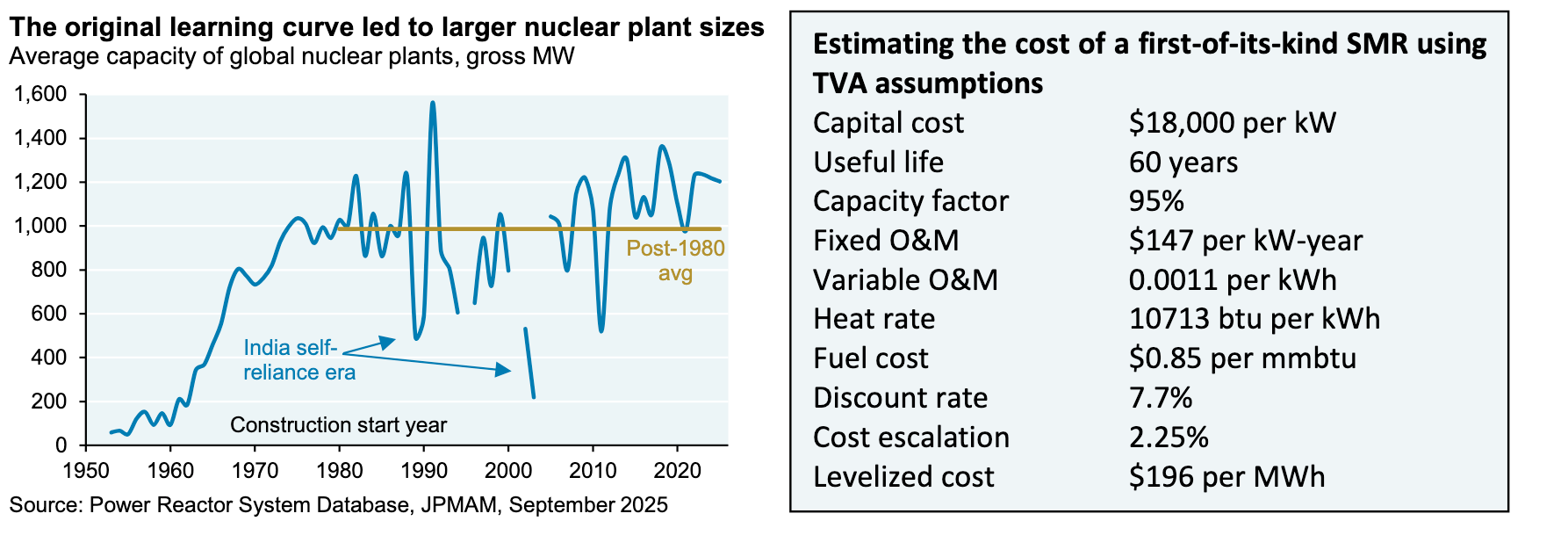
The graphics above are from page 38 of Cembalest’s report. The reference to TVA arises out of the fact that the Tennessee Valley Authority analyzed SMRs in its 2025 integrated resource plan,2 Cembalest notes. He reports that using TVA assumptions, conservatively grounded in that utility empire’s detailed exploration of SMR potential at its Clinch River facility, “first-of SMR levelized costs would be $196 per MWh, possibly falling to $150 per MWh assuming a 30% future decline in capital costs.”
Reality check: We just emerged from a very cold winter, which put significant upward pressure on wholesale electricity prices. Real-time prices in January, according to data from regional grid operator ISO New England, were $142.70 per MWh on average. On February 1, the state’s largest electric utility (Eversource) implemented a default energy service price of 11.3 cents per kwh. That price, which will be good through the end of July, enjoys the imprimatur of the Public Utilities Commission, and reflects a fair degree of prognistication of what spot energy prices will be during the period, works out to $113 per MWh.
Should New Hampshire volunteer to swap out $113 power, or even $143 power, for energy that is likely to cost nearly $200 per MWh — in the name of becoming an early adopter of SMR technology? Governor Ayotte apparently answers that question in the affirmative.
“New Hampshire seeks to strengthen the reliability of our electric grid and foster long-term cost stability while also protecting our ratepayers,” she wrote to the Trump Administration on April 1 in her cover letter to the state’s response to a request from the U.S. Department of Energy for expressions of interest in hosting “Nuclear Lifecycle Innovation Campuses,” whatever they are. “Advanced nuclear can provide both our state and region with economic benefits creating clean dispatchable energy while modernizing our grid and providing needed additional generating capacity for our region,” Ayotte continued. “We are confident that these goals align with the administration’s Energy Dominance strategy.”
Her cover letter helpfully reminded the Trump Administration that New Hampshire is the only state in New England that has never adopted a moratorium on building nuclear power plants. The federal submission includes, highlighted in yellow, an indication of a “high” level of interest in “Advanced Reactor Deployment” and lists various legislative enactments from 2024 and 2025 whose purpose is to encourage the development of new nuclear power. At least one additional pro-nuclear bill is currently pending.
Viewing the prospect of SMR deployment from an investor perspective, Cembalest added some warnings related to that “Energy Dominance” strategy that Governor Ayotte mentioned in her letter. “While the [Trump] Administration is supportive of advanced nuclear designs like SMRs, changes in nuclear regulatory oversight might make investors, utilities and other private sector actors nervous about the consequences. [President] Trump’s February 2025 Executive Order stripped independent oversight authority of the US Nuclear Regulatory Commission and gave the OMB the power to review agency actions to ensure consistency with the President’s policies and priorities. According to a former NRC chair, ‘the executive order implies that there are no longer independent regulators free from political and industry influence.’”3
I am not here to harsh anyone’s nuclear vibe — not the Governor’s, not her Department of Energy’s, not the General Court’s, not the Town of Seabrook (whose selectboard wrote a letter of support included in the April 1 submission to the feds), not NextEra (which owns Seabrook station and would love to build more nuclear capacity there, and also added a letter), not StarCube (another letter, this one from a Portsmouth-based company with, apparently, plans to construct some kind of pilot SMR facility), nor Eversource (whose letter from New Hampshire president Robert Coates included a vaguely worded promise to be helpful). But if J.P. Morgan’s antennae are up, so should those of the ratepayers’. Just sayin.’
Care to download and read the whole danged thing? I dare you.
Remember when New Hampshire used to require periodic Least-Cost Integrated Resource Plans (LCIRPs) from electric and gas utilities, explaining how these companies intended to deploy all of their resources in the future? The General Court repealed this requirement in 2023, replacing it a year later with a much narrower requirement for “Integrated Distribution Plans” (which, unlike the LCIRP requirement, has no enforcement teeth). The first of these plans, from Eversource, is not due until September 1, 2026. Liberty has been told to file one year later with Unitil’s required on September 1, 2028.
The former NRC chair Cembalest quoted is Allison Macfarlane, who held the post during the second term of the Obama Administration.
Thanks Don, for injecting a much needed dose of reality into the conversation around meeting NH's electricity needs. Desperation seems to be driving our state's energy policy if SMRs are hyped as a solution in the short or even medium term.