
Ten Years In . . .
. . . still the Best Job in New Hampshire State Government.

Ten years ago — on February 13, 2016 — I marched into the Office of the Consumer Advocate on the first floor the Walker Building on Fruit Street in Concord and took up my dream job: Consumer Advocate, tasked with leading the feisty little state agency with the big job of sticking up for residential utility customers.
I am among the fortunate few. Most people settle for professional opportunities that are Faustian bargains to one degree or another, as I myself have done on more than one occasion over almost 45 years in the world of working adults. But the Office of the Consumer Advocate is an agency that always does what is right, period.
Moreover, as Consumer Advocate, I enjoy almost unparalleled independence. Though nominally part of the executive branch of state government, none of the three governors under whom I have worked has ever attempted to guide or constrain me. There is the Residential Ratepayers Advisory Board (RRAB), which by statute plays a key role in determining who gets to be the Consumer Advocate. My practice has been to treat the RRAB the way an executive director of a nonprofit would treat his board of directors — and the board, under the able leadership of first Claira Monier and then Tom Moses and now Dana Nute, has rewarded me with unwavering support, respect, and kindness.
Over my decade of service, I’ve gone from being the newest person in the office to the most senior. The attorneys (ranging, among other things, from former students to former adversaries) who have toiled with me on behalf of the state’s residential customers have been some of the best in the business. So, too, with the analysts — smart experts all, never faltering on the stand in the face of cross-examination by aggressive utility lawyers who know that our people are often all that stands between them and the unfettered pursuit of utility shareholder profit. Our two legal assistants — first Jamie Breen and now Lesley LaPerle — have had my back at all times while often serving as impromptu amateur therapists on those days when even the best job in state government becomes a challenge to one’s sanity.
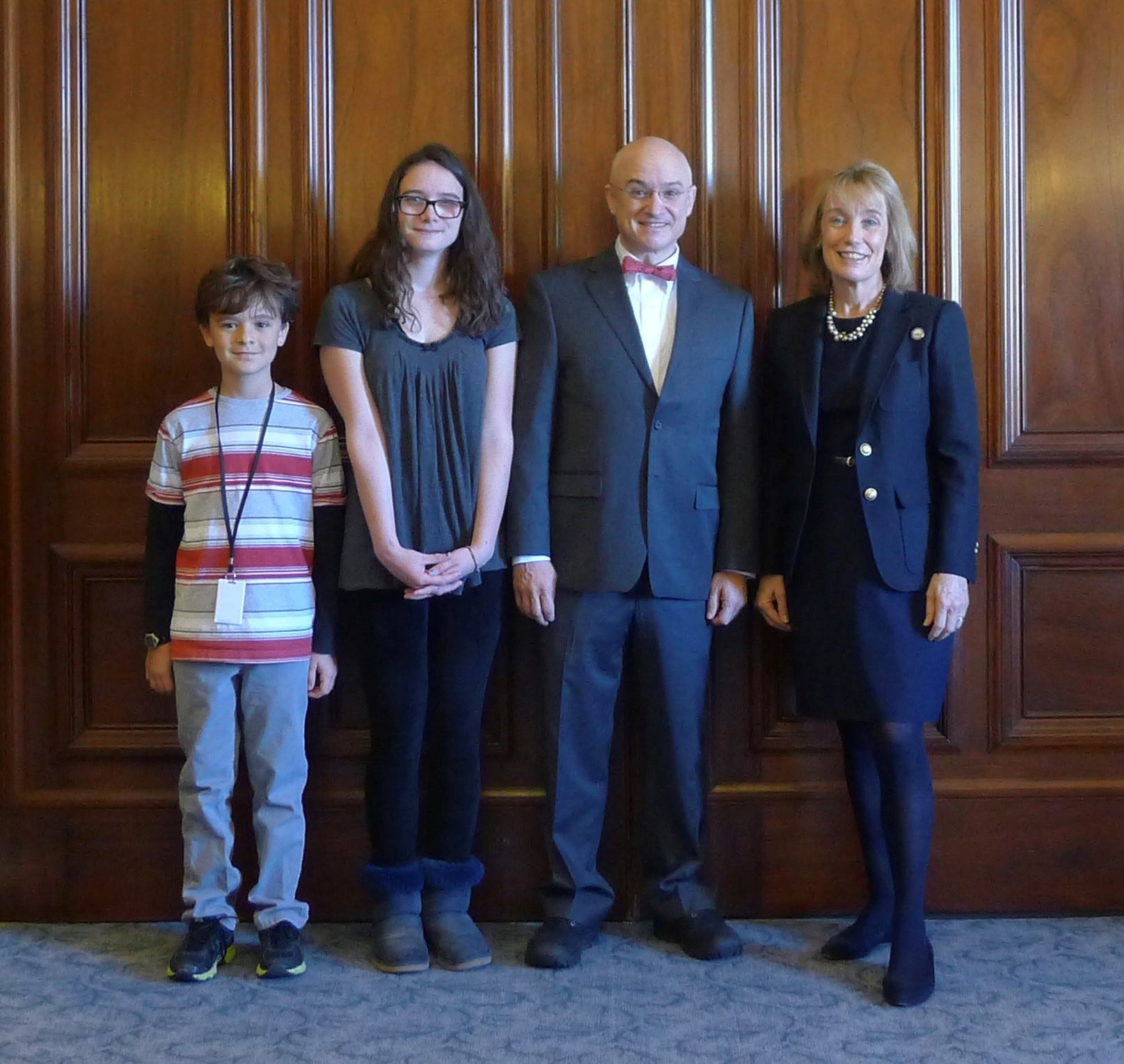
Not too long after I took office, I had the pleasure of heading to the State House with my two kids for a ceremonial swearing-in with the Governor who first appointed me, Maggie Hassan. An indelible memory is the Governor telling the kids how lucky New Hampshire and its residential utility customers were that I had agreed to do this job — clearly, you don’t get to be Governor without learning how to emit ministerial blarney. Upon returning to the office with the kids, I made the mistake of bragging to my staff that the Governor had said nice things about me. “Yeah — for, like, a minute,” sneered my youngest.
“That’s a minute more praise than you’ve ever gotten out of a Governor,” I shot back. Kids do keep their dads humble — and they do make us proud too. A decade later, my daughter actually works on the staff of a Governor (though not ours) who, in her dad’s presence, has made clear that my eldest might be the best thing to happen to Maine since the invention of the whoopie pie. Or something like that.
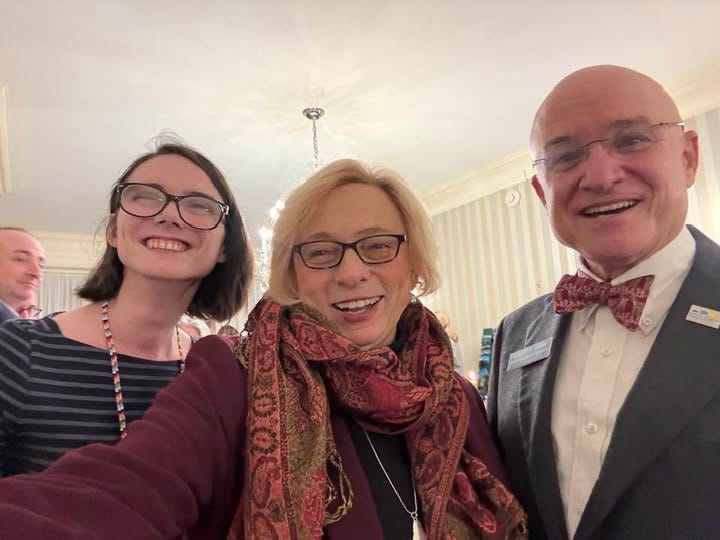
[Above: Rose, her boss, and her dad at the Blaine House in Augusta .]
When I took office I had some confidence that I knew how to succeed before the Public Utilities Commission, which is the principal objective of the job. After all, I had worked at the PUC from 1999 to 2008, eventually becoming the agency’s general counsel under Chairman Thomas Getz. But I was a bit nervous because, until I took office as Consumer Advocate, I had never met Chairman Martin Honigberg and did not know if he would welcome my flavor of advocacy. But he did! It was always a pleasure to appear before Chairman Honigberg, not because we share a sense of humor (though we do) and not because he always agreed with me (he didn’t) but because in the hearing room he was always very transparent about about whether I was being persuasive and cogent — or not.
My all-time favorite PUC Commissioner, however, is unquestionably Kate Bailey. Kate and I go way back; she was one of the first people I met at the PUC when I showed up in August of 1999 as a fledgling staff attorney and she was the assistant director of what was then the PUC’s engineering division. From the inside I knew her as the consummate PUC analyst — thorough, skeptical, creative, and courageous. In due course, she brought exactly these qualities to her work from the bench. “What will Kate ask?” was always the gold standard for witness preparation during the Bailey era. It is regrettable that the vote Kate Bailey cast as a member of the energy facility Site Evaluation Committee against moving forward with Eversource’s Northern Pass transmission project cost her a second term on the PUC.
I say that as someone who might surprise you with the opinion that I wish Northern Pass had been built. Plan B — the NECEC transmission line in Maine — recently went on line and began delivering more than a thousand megawatts of Hydro-Quebec electricity for Massachusetts, and it hurts a bit to see the Mills Administration justifiably bragging about $240 million in benefits to Mainers. That money could have gone to us in New Hampshire.
Why didn’t I take a public position on Northern Pass back when it was pending? Because Eversource never asked, nor did it offer me any ratepayer guarantees of the sort NECEC’s developer (Central Maine Power) presented to my counterpart in the state next door. Why am I mentioning Northern Pass here?
Because I respectfully contend that my take on that particular doomed transmission project is emblematic of my approach to being Consumer Advocate. I strive to advance the cause of New Hampshire’s residential ratepayers, no matter who I annoy. Environmental advocacy is not part of my portfolio. Whether you’re Bill McKibben or the Koch Brothers, whether you lobby for solar interests or nuclear interests, if you are here to extract free money from ratepayers I will fight you. If you are here to help ratepayers I will support you.
One ineluctable reality of the job is its adjacency to partisan politics, especially in these ultra-partisan times. The trick is staying nonpartisan without cultivating any disdain for partisan politics, which enjoy a legitimate place in our system of government.
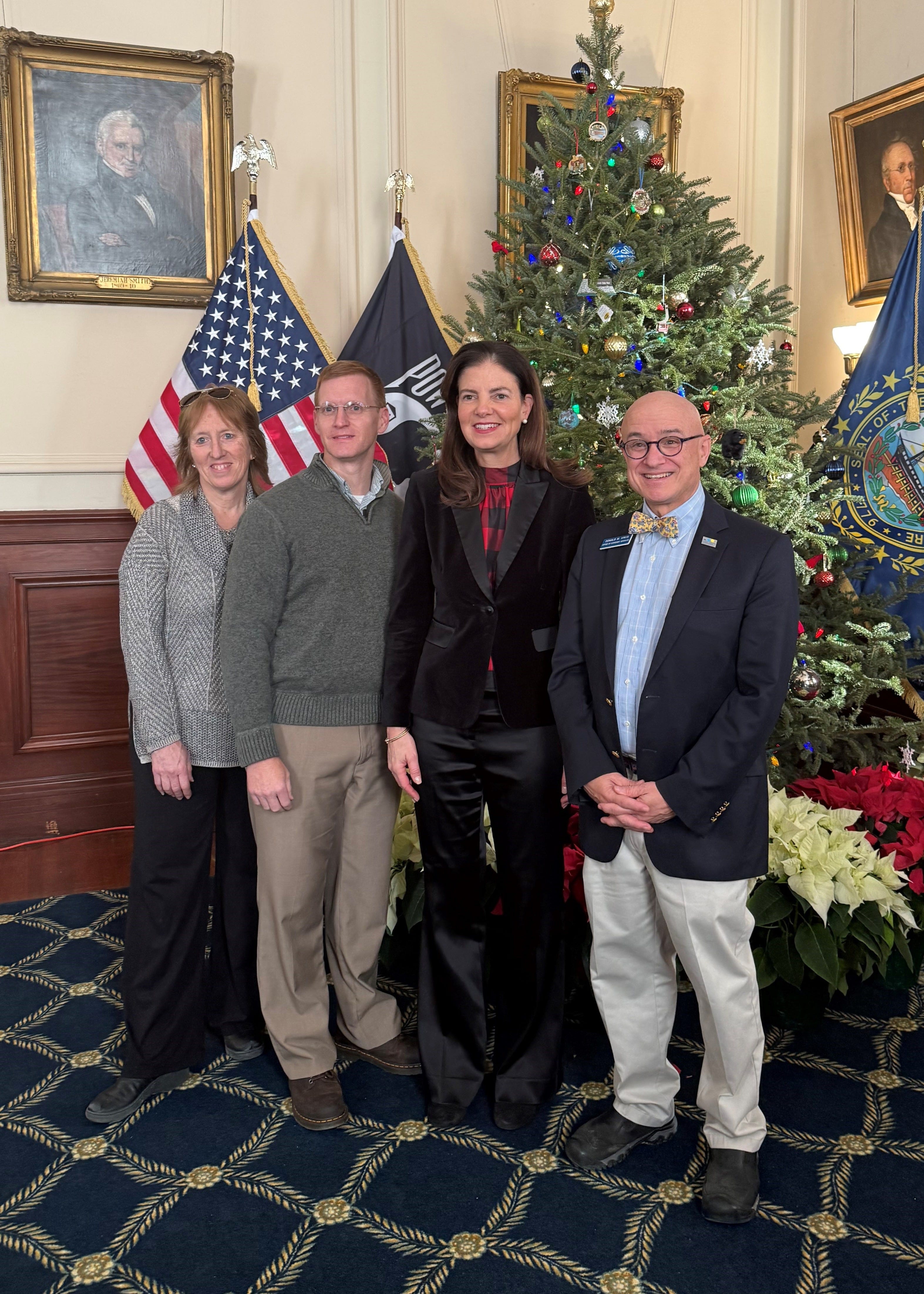
[Me and most of the OCA crew greeting Governor Ayotte at her 2025 Holiday Tea. I have a similar picture with Governor Sununu, but I can’t seem to find it, alas.]
Though I am an “undeclared” New Hampshire voter, I grew up in a Democratic family. My dad famously looked up from his New York Times one day in 1974, at the height of the Watergate scandal, and said: “I don’t see what the big fuss is. I’ve known Nixon’s a crook for 20 years.” There are portraits of Justice Louis Brandeis and Eleanor Roosevelt on the wall of my office, along with pictures of me and my daughter with President Biden, taken when my daughter introduced a speech Mr. Biden gave in New Hampshire about drug prices during the last year of his presidency. To the extent those facts brand me a Democrat, I will simply say that nothing has given me greater pleasure over these ten years than finding common ground, and common purpose, with Republican politicians and policymakers. The New Hampshire Republican I admire most is probably Representative Michael Vose of Epping, chair of the House Committee on Science, Technology and Energy. He is a skilled but honorable legislative tactician, and I respect people who play that particular game to win. Relatively early in my tenure I discovered that Michael and I have something in common that is deeply personal to each of us — something that transcends his work, or mine — and I will simply say here that it is profoundly satisfying to forge connections of that kind.
Two days prior to my anniversary I testified before the New Hampshire Senate in favor of House Bill 610 — an astonishing reversal. Originally the bill would have abolished the Office of the Consumer Advocate. Then the bill was amended so that it made the Consumer Advocate serve at the pleasure of the Governor, eviscerating our independence. I and members of my advisory board worked hard to understand and then address the concerns of the bill’s sponsors and champions, and ultimately we got this proposal to the point where it meets their needs (principally, to assure that the Office of the Consumer Advocate does not become an environmental advocacy organization) without compromising the independence and autonomy of our office. The year-long HB 610 journey is perhaps the most pleasant surprise of my decade at the helm of the OCA — so far.
Though it is difficult to know for sure, I think the reason some people consider me an environmental advocate is that I have found common purpose with groups like No Coal No Gas and Fix the Grid when it comes to pushing back against our imperious and unaccountable regional grid operator, ISO New England. Thanks in part to those groups, what used to be a torpid coffee klatsch — the ISO New England Consumer Liaison Group (CLG) — is now much closer to achieving the purpose for which it gained approval from federal regulators a decade and a half ago: to serve as a meaningful conduit between ISO New England’s board and the ratepaying public ultimately served by ISO New England.
I think ISO New England is moving in the right direction. The external relations team is newly open to improving the CLG’s parameters so that it reaches more people and fosters more dialogue. A new CEO, Vamsi Chadalavada, took over on January 1 and sets a decidedly different tone than his imperious predecessor.
We too are moving in the right direction when it comes to our engagement with the regional forums and entities that control our wholesale electricity markets and bulk power transmission system. We are focused there for the same reason Willy Sutton robbed banks — because that’s where the (ratepayer) money is. Two years ago we expanded our staff by adding a director of regional and federal affairs to assure that we make meaningful use of our voting membership in NEPOOL, the very powerful ISO New England stakeholder ‘advisory’ body. We were fortunate to attract Matthew Fossum, one of the best utility lawyers in New Hampshire, to the position and he has been doing a superb job. We are working alongside our counterparts in the region to put a stop to unscrutinized spending on so-called “asset condition” transmission projects — the replacement and upgrade investments that have come to dwarf the development of new transmission facilities.
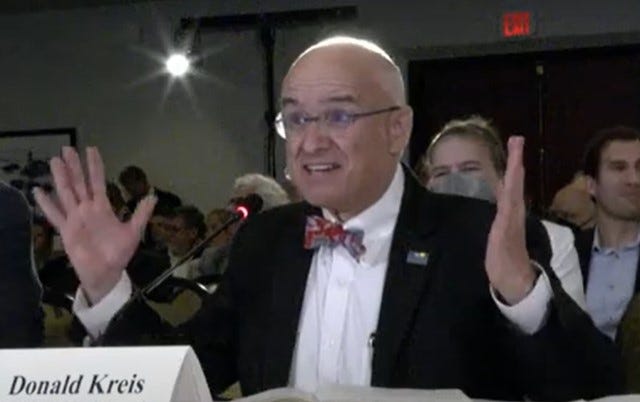
[Me, addressing the Federal Energy Regulatory Commission when it visited Portland, Maine.]
Looking back on the past decade, there are a few substantive things we’ve done at the Office of the Consumer Advocate of which I am especially proud.
One is the seven years of work we’ve put into developing a statewide, multi-use, utility customer data platform. According to the Green Button Alliance, today’s readily available technology would allow us to “empower energy users to digitally access their own energy-usage data, manage energy consumption, and save resources.” The trade group mission:data has an impressive list of companies — not regulated utilities with captive customers but entrepreneurial outfits that stand ready to compete with each other to deliver value to consumers — if only it were easy for them to gain access to granular usage data when authorized by their customers.
Back in 2019, it was obvious to us that what initiatives like this needed in New Hampshire was the kind of kick in the pants that could only be administered via legislation telling the state’s utilities, and the state’s utility regulators, to get this done. So we drafted a bill, recruited sponsors, worked hard to refine the bill to accommodate various stakeholder concerns, and persuaded Governor Sununu to sign the measure into law. It was one of only two energy-related bills he signed that session, 2019 being last year in which Democrats were the majority party.
What happened next truly astonished me. It took a couple of years but we managed to build not one but two awesome things. The first was a set of basic parameters on how we could create one-stop shopping for third parties interested in serving customers throughout New Hampshire, without forcing the utilities to compromise the fortress-like integrity of their back-end systems. (The answer turned out to be something the data nerds refer to as an “API of APIs.” API means “application programming interface.”) The second thing we pulled off — even more remarkable from my perspective — was a consensus-based governance paradigm in which the utilities, in essence, agreed to build the thing while sharing oversight with outside stakeholders, our office included. This offers a model for future initiatives that take advantage of the utilities’ systems without awarding them even more hegemony.
Regrettably, the data platform is now in hospice as a bill to repeal the statute signed into law seven years ago is about to arrive at Governor Ayotte’s desk for her signature. Politics of the pettiest sort killed off this excellent project . . . I guess that’s ‘nuff said about it.
We will not allow the same fate to crush the state’s ratepayer-funded Energy Efficiency programs, administered by our electric and gas utilities under the NHSaves banner. Five and a half years ago — on November 12, 2021, a day that will live in infamy — the PUC rejected the proposed 2020-2022 triennial energy efficiency plan (yes, more than 300 days after the triennium started) and announced that it was phasing out the whole program. It was the final act of PUC Chair Dianne Martin, issued on the evening of her final day in office. (Side note: Yes, I am taking about that Dianne Martin.)
The OCA filed an appeal, along with others who share our view that ratepayer-funded energy efficiency is important because negawatts are cheaper than megawatts. Incidentally, in case you are wondering why I am always careful to put “ratepayer-funded” in front of “energy efficiency,” here’s the reason: The utilities do not invest one cent of their own capital in these programs; they simply operate NHSaves and receive healthy performance incentive payments (on top of recovery of lost fixed-cost revenue) in exchange. And of course the utilities love to link their brands to the ratepayer-funded NHSaves logo; what with constantly escalating rates these companies need something to make customers feel warm and fuzzy about them.. But I digress.
Negawatts are not cheaper than megawatts out to infinity. There does come a point at which it would be more cost effective to invest the next dollar in supply-side capability, but in New Hampshire we are so far from that point as to make the possibility irrelevant. We ultimately withdrew our appeal because in 2022 the General Court adopted, and Governor Sununu signed into law, a landmark bill that for the first time requires utilities to offer energy efficiency programs funded via (extremely modest) nonbypassable charges on utility bills. Today we are busy working the utilities on developing the 20278-2029 triennial energy efficiency plan. Key challenges include: Getting the utilities to get real, at long last, about on-bill financing of customer contributions to energy efficiency investments, and keeping the discount rate to a suitably low level. The discount rate is what we use to determine the net present value of energy efficiency savings, which can accrue for as long as 30 years, for purposes of deciding what’s cost effective. If you like ratepayer-funded energy efficiency you argue for a low discount rate (e.g., 2 percent) and if you don’t like the programs you strive to kill them via the use of a big discount rate (e.g., the utilities’ weighted average cost of capital, between 7 and 8 percent). It’s completely subjective and don’t let anyone tell you otherwise.
Speaking of numbers that most people incorrectly view as arcane, I am proud to be, and shall remain, the Captain Ahab of bloated utility return on equity (ROE). Regulators — not just in New Hampshire but pretty much everywhere — have been routinely doling out millions and millions in free money to utilities based on excessive ROE since — well, since forever.
As ROE expert Mark Ellis persuasively demonstrated last year in a paper for the American Economic Liberties Project, utility regulators have been embedding an average 9.6 percent ROE in rates for electric utilities — well above the average return on investment for publicly traded corporations throughout the economy. This makes no sense because (1) ROE is supposed to compensate shareholders for the risks they assume, and (2) utility shareholders face less risk than owners of typical companies because utilities provide an essential public service to captive customers. A high-flying pharmaceutical company, working on things like gene therapy and mRNA technologies, Eversource is not. And yet our PUC awarded Eversource an ROE of 9.5 percent last year — a determination we just appealed to the New Hampshire Supreme Court.
“The result is a vicious cycle of ever-increasing rates,” Ellis wrote. “In just the last few years, average IOU residential rates have increased 49 percent more than inflation.”
Excessive ROEs don’t just raise rates directly; they also drive utilities to over-invest in what becomes the opposite of a virtuous cycle. Marissa Gillett, until recently the chair of Connecticut’s utility regulator, took on this problem aggressively and was hounded out of office by her state’s utilities as a result.1

[Above: My crystal ball. Unlike most public officials I cannot claim to lack one.]
It is gratifying, after a decade as my state’s ratepayer watchdog, to see politicians across the spectrum, in New Hampshire and everywhere else, raise the alarm about electricity becoming unaffordable. The same can (and should) be said about the other big regulated industry in New Hampshire — natural gas. (As I write, Liberty just filed a request for yet another emergency increase in natural gas rates that will push an average monthly bill up by 45 percent, thanks to wholesale prices having skyrocketed during what has been a notably cold winter.) Less gratifying are the answers that always seem to be proffered, involving subsidies to the left’s favored technologies (solar, wind) or the right’s (natural gas and, more recently, the development of new nuclear capability). The correct answer? Better demand-side management so we use less electricity and gas at ultra-expensive peak times, less “sludge” that stands in the way of people switching among sources of electricity, and more reliance on energy efficiency.
As a lawyer, I see principal/agent problems everywhere I go — that’s been a persistent theme these past ten years. In my opinion it is folly to base energy or utility policy on an expectation that people will be vigilant “prosumers” — regular people are simply too busy for that, as they raise their families, pursue their careers, and enjoy their retirements. So the question becomes: Whom do you trust to act on your behalf? As a principal, who should be your agent? Your friendly neighborhood investor-owned utilities, answerable to distant management and shareholders? Some unregulated firm that doesn’t even have a regulator looking over its shoulder? Principal/agent issues are the reason I remain bullish on institutions like the Community Power Coalition of New Hampshire (a consortium of municipalities, working as the wholesale buying agent for people in member towns and cities) and the New Hampshire Electric Cooperative (a utility with no shareholders that is owned and democratically controlled by its customers).
We’ve striven, over these past ten years, to serve as faithful agents of residential utility customers. To my knowledge, I am the seventh person to hold the title of Consumer Advocate in New Hampshire since the office’s creation in 1981, my predecessors (in chronological order) being Gerald Lynch, F. Joseph Gentili, Michael Holmes, F. Anne Ross, Meredith Hatfield, and Susan Chamberlin. I’ve known all but the first two and can attest that I stand on the shoulders of giants. From that vantage point the present looks solid and the future looks . . . interesting, maybe bright. My earnest thanks to the residential ratepayers of New Hampshire for the opportunity to represent them for this past decade.
I have lots of friends in the world of utilities and utility regulation in Connecticut, and several of them have urged me to stop coming to the defense of Marissa Gillett. They point to claims of improprieties within the regulatory agency on the watch of the former chair. I express no view about those claims beyond noting that if you dig deep enough about any head of any state agency anywhere, and pound that official with public records requests and other hostile incursions, and you keep hunting until you find something, you’re bound to find something. Trust me, I know.
Sorry to read of your admiration for Michael Vose. His policies seem to be directly opposite of your pitch about Negawatts.