
Not so fast!
Why I just filed yet another challenge to the PUC's decision in last year's Eversource rate case.

Anyone who considers last year’s Eversource rate case as decided by the New Hampshire Public Utilities Commission to be a done deal should think again, in light of the rehearing motion I just filed (in my capacity as New Hampshire’s Consumer Advocate) on behalf of the state’s residential ratepayers.
This case was wrongly decided last summer, and the Commission doubled down on its mistakes in its rehearing order of December 31. So we were compelled to follow up with an additional rehearing motion, prior to taking our case to the New Hampshire Supreme Court.
Bloated Return on Equity -- Still Not Okay
In particular, the latest OCA motion raises new and additional concerns about the PUC’s massive award of free money to this investor-owned utility in the form of the bloated return on equity embedded in the rates approved last year. In its initial rehearing motion, the OCA took the PUC to task for ignoring our two expert witnesses. The PUC apparently agreed these witnesses should not have been ignored – so, instead, the regulators decided to ridicule and misinterpret them.
Essentially, the PUC succumbed to groupthink in awarding Eversource a 9.5 percent return on equity because that’s what all of the other regulators are awarding all of the other utilities these days. But our witnesses showed that 8.1 percent is a better answer, even erring on the side of being generous to Eversource’s shareholders. For the PUC, that’s an inconvenient truth, so they trashed one of our witnesses (ROE expert Aaron Rothschild) and misinterpreted the other (PhD economist Marc Vatter).
PUC Punt on Alternative Regulation -- Definitely Not Okay
Another example of free money being awarded to Eversource is the so-called alternative regulation plan approved by the PUC last summer. In our latest rehearing motion, we challenge the PUC’s refusal to change course even in the face of one commissioner, Interim Chairman Mark Dell’Orfano, concluding that the plan approved last July “does not establish a valid alternative regulation plan . . . and cannot result in just and reasonable rates.”
Ordinarily, that’s the sort of thing one might expect to see in a dissenting opinion (although I do not understand why Interim Chairman Dell’Orfano signed onto the Commission’s order issued in July, approving that very same alternative regulation plan). But in this instance there are only two commissioners – and denying a rehearing motion based on a 1-1 deadlock is not a valid outcome under the PUC’s enabling statute.
The PUC compared this outcome to what happens when an appellate court, like the U.S. Supreme Court, is evenly divided. And, indeed, when an appellate court is deadlocked then the decision under review is affirmed. But the PUC is not an appellate court and this analogy does not hold up as a matter of law.
Looming Disqualification Issues
Our latest rehearing motion argues that in this situation the PUC was obliged to ask the Governor to appoint a special commissioner to break the deadlock.
One might be tempted to conclude that the Commission can easily resolve this problem once the Governor’s nominee as the next PUC Chair, Christopher Ellms, is confirmed and the Commission once again has three voting members. Alas it is not so.
The state’s code of judicial conduct applies to PUC commissioners, and Rule 2.11 of the code requires disqualification when the decider ‘served in governmental employment, and in such capacity participated personally and substantially as a lawyer or public official concerning the proceeding.
Mr. Ellms is the deputy commissioner of the state’s department of energy and has served in that capacity since the department was created almost five years ago. As the number two official of the Department of Energy, Chairman-Designate Ellms cannot disclaim involvement in developing the Department’s positions before the PUC – and the Department is a party to every single PUC docket. That’s especially true of a major, controversial docket like the Eversource rate case.
A Capitulation on Prudence Review
This may seem like inside baseball, but the alternative regulation plan approved by the PUC for Eversource last summer is a big deal for the state’s residential customers. In its order of last July 25, the Commission (to its credit) rejected a complicated alternative regulation proposal advanced by Eversource but instead adopted “a simple 1.42% productivity factor to provide the Company with the revenue necessary to run its business in line with similar electric distribution utilities.”
Translation: Free money for Eversource, in the form of an automatic 1.42 percent increase in distribution rates that goes into effect unless “spending is more than target, avoiding long, detailed, and arduous annual spending reviews.”
The phrase “long, detailed, and arduous annual spending reviews” can be translated as “scrutiny to assure that Eversource spending is prudent, especially because runaway capital spending combined with bloated utility ROE is the fundamental reason for the affordability crisis.”
The Future of Alternative Regulation
These concerns are presumably the reason for Governor Ayotte’s publicly expressed opposition to alternative regulation plans for utilities, and for the bills pending in both the New Hampshire House and the New Hampshire Senate that would repeal the existing explicit statutory authority to approve alternative regulation plans.
I share, and commend, Governor Ayotte’s skepticism along with that of the sponsors of the repeal bills. But let’s not kill all the whales in the ocean if our real target is just the evil white whale Moby Dick. Alternative regulation plans built around performance incentives, which reward utilities for good performance from a customer perspective and punish them for bad performance, are a great idea. Alternative regulation plans that simply give utilities free money without scrutiny should be outlawed.
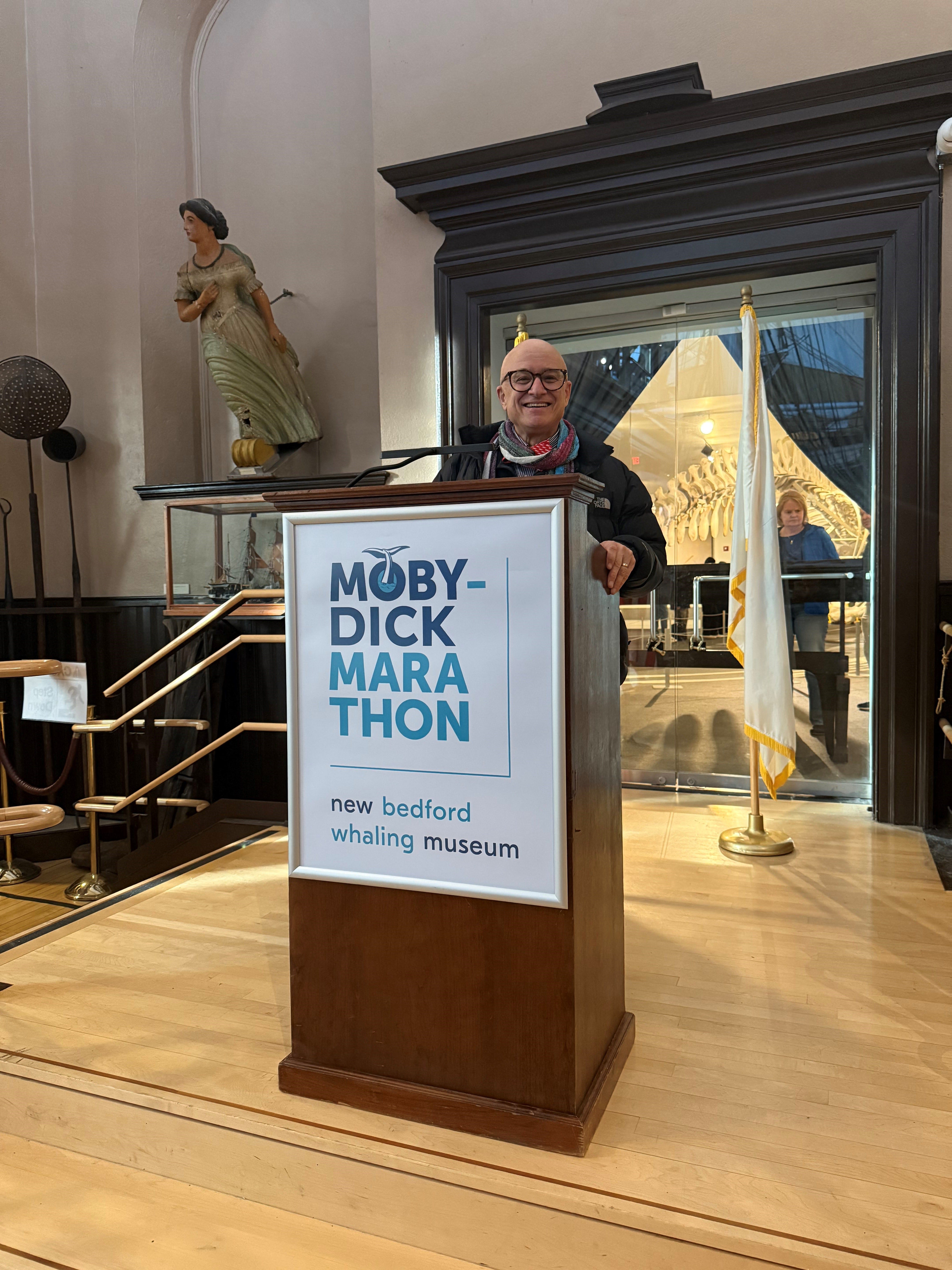
[Note: A slightly different version of this post, minus the picture of me at the podium of the recent Moby-Dick Marathon, appears on the web site of my office, oca.nh.gov.]